Part 1 of 6 in the "Chinese herbs and Western medication" series. This part gives the answer; the other five are listed at the foot.
"I'm on blood-pressure medication. How long do I wait before taking the herbs you prescribed?" A question that comes up often is this one, from someone already on Western medication, curious about TCM, and worried the two will clash.
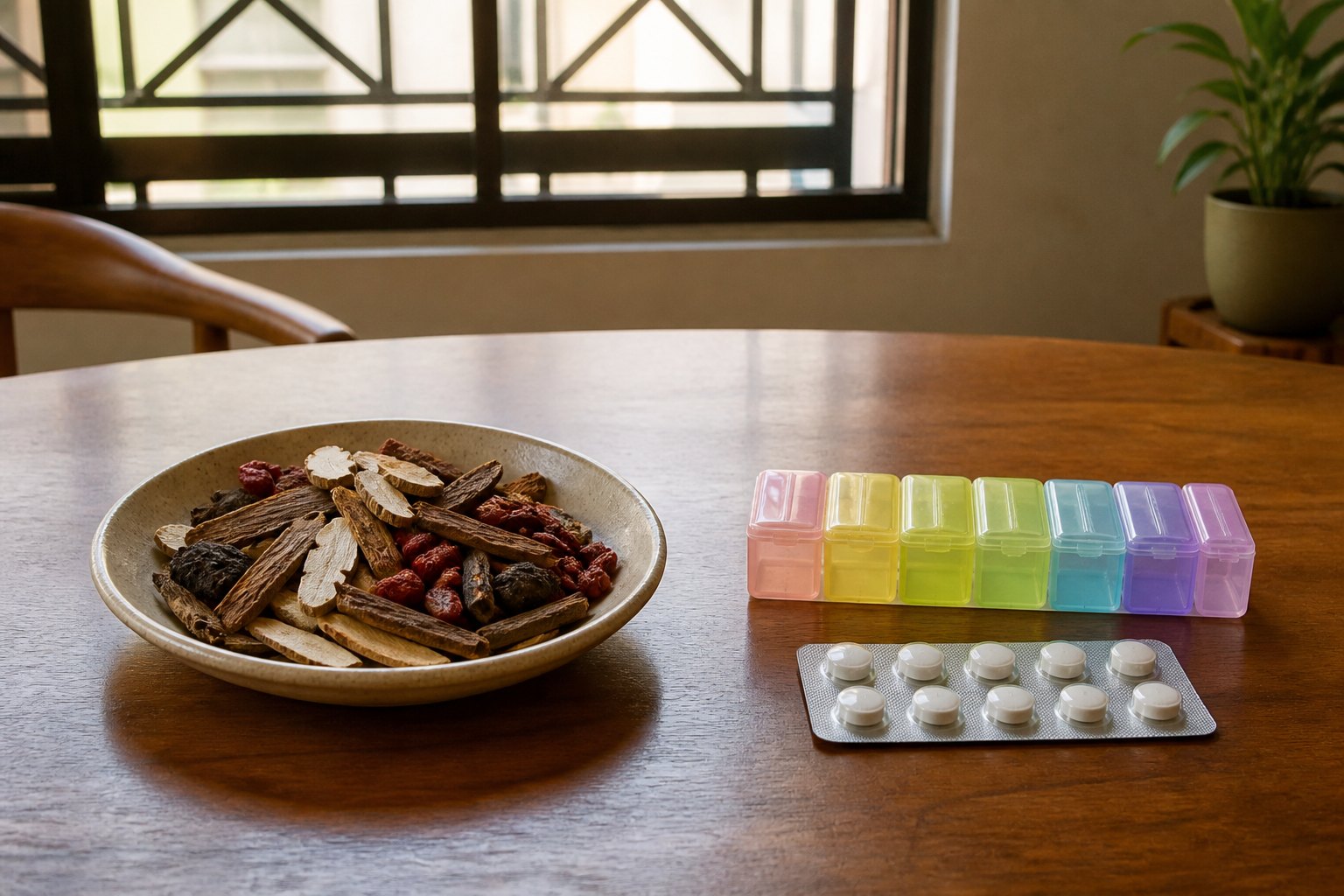
The answer first. Used properly, most Chinese and Western medicines are generally safe to take together, and the usual practice is to space them at least one to two hours apart — that is the position of the Chinese medicine pharmacist team at Hong Kong's Hospital Authority, in its Chief Pharmacist's Office. HansMed's condition is: both practitioners know.
"Used properly" has conditions. This series sets them out across six parts. This one answers the first two things: why herbs can affect Western medication at all, and the one thing never to do.
The short version
- Used properly, most Chinese and Western medicines are generally safe together, and the usual practice is at least one to two hours apart — that is what the Hospital Authority's Chinese medicine pharmacist team writes. HansMed's condition is that both practitioners know. But spacing is not safety — part 3 sets out what the gap reaches and what it does not.
- "Herbs are natural, so they're gentle and harmless" is a common misunderstanding. Herbal medicines contain biologically active constituents, and anything with an effect can affect other things with effects.
- Interactions divide into pharmacodynamics and pharmacokinetics — that is the Hospital Authority's split: the first is what medicines do to the body, the second is what the body does to medicines. The six routes are in parts 2 and 3.
- Supplements, vitamins, herbal teas and tonics you drink regularly all sit inside the same consideration. Herbal tea has no clear unified standard and each shop's recipe may differ — that is from the Hospital Authority's lecture material.
- Never stop, reduce or adjust a Western prescription because you have started seeing a TCM practitioner. That one is set out below, and it is the most important sentence in the series.
First, the one thing never to do: never stop your Western medication on your own
If you remember one thing from this series, make it this one.
Do not stop, reduce, or adjust any prescribed Western medication because you have started seeing a TCM practitioner.
Whether the reasoning is "the herbs should be enough now" or worry about the two clashing, changes to a prescription are decided by the doctor who wrote it. Stopping on your own carries its own risk; some medications must not be stopped abruptly.
If reducing or stopping is on your mind, raise it at your next Western medical appointment and let the prescribing doctor judge.
TCM is complementary care, not a replacement. A responsible TCM practitioner will not advise you to stop a Western prescription. If someone does, that in itself is a warning sign.
The five parts that follow name a number of Western drug classes. Whichever one you recognise, never stop on your own — take the list and the question to the prescribing doctor.
⚠️ A safety note: TCM and Western medicine complement each other. It is not a choice between them.
A note: this section is general information only. For conditions like these, follow your doctor's diagnosis and treatment, and seek medical attention when you need it.
I. Herbs are medicine, which is exactly why they can interact
"Herbs are natural, so they're gentle and harmless" is a common misunderstanding. Herbal medicines contain biologically active constituents, and anything with an effect can affect other things with effects. That is not a flaw of Chinese herbs; Western medications interact with each other for the same reason.
Interactions divide into two kinds, called pharmacodynamics and pharmacokinetics — that is the Hong Kong Hospital Authority's split. The Authority's own gloss: pharmacodynamics is what a medicine does to the body, pharmacokinetics is what the body does to a medicine. In everyday terms, the first is two medicines adding to or cancelling each other's effect on the body; the second is one medicine changing how the other is absorbed, metabolised or cleared.
Each kind has its own concrete routes. The pharmacokinetic half opens into four stations, in part 2; the two pharmacodynamic routes are in part 3.
💡 Remember: it is medicine, so someone qualified arranges how it is used. Neither "natural, so anything goes" nor "risky, so never".
II. All of it counts: supplements, vitamins, herbal teas, tonics
More has to be counted in than most people assume.
- Supplements, vitamins, herbal teas and tonics you drink regularly all sit inside the same consideration.
- Patent medicines, concentrated granule powders and herbal decoctions follow the same rule. None of them "counts less".
Herbal tea needs a sentence of its own. 凉茶 has no clear unified standard, and each herbal-tea shop's recipe may differ — that is written in the Hospital Authority's lecture material. Its own example is 五花茶, "five-flower tea": among the recipes on the market, some use 鸡蛋花 frangipani, some swap it for 葛花 kudzu flower, and some use 绵茵陈 and 夏枯草 instead. One name, and not the same set of herbs underneath it. So at the consultation, say which shop, which tea, and how often.
How herbal teas, tonics and supplements fit into life in Malaysia has a section of its own in part 6.
The words in this part
- Pharmacodynamics (药效学) — the Hospital Authority's gloss: what a medicine does to the body. Two medicines adding to or cancelling each other's effect belongs here.
- Pharmacokinetics (药动学) — from the same material: what the body does to a medicine, which is how it is absorbed, distributed, metabolised and cleared. All four stations in part 2 sit under this one.
- 凉茶 (herbal tea) — the Hospital Authority's lecture material notes that 凉茶 has no clear unified standard and each shop's recipe may differ. Which is why, on a medication list, it needs its ingredients described rather than just its name.
- MAL registration number — from Malaysia's Ministry of Health Pharmaceutical Services Programme: a valid registration number begins with "MAL", followed by eight digits, and ends with a letter indicating the registration category. It is the number on the box.
- Meditag hologram — from the same FAQ: registered medicines must carry both the registration number and a Meditag hologram on the label or packaging. The category letter T is Natural Products/Traditional Medicines, which is where proprietary Chinese medicines are registered.
Frequently asked
Will taking Chinese and Western medicine together harm my liver and kidneys? The Hospital Authority's pharmacist team holds that, used properly, most Chinese and Western medicines are generally safe to take together. In Malaysia, registered medicines, traditional and proprietary Chinese medicines included, carry a registration number beginning with MAL and a Meditag hologram on the packaging — that is from the Ministry of Health's Pharmaceutical Services Programme FAQ; products and remedies of unknown origin, or with no registration number, sit outside that review. The fuller discussion is in "Do Chinese herbs carry risks? 5 things about using them safely" (/chinese-herb-safety/).
I forgot to mention my Western medication at the TCM consultation. What now? Contact the practitioner now and add it. Hold off starting the herbs until the practitioner has seen the list.
A note: this section is general information only. For conditions like these, follow your doctor's diagnosis and treatment, and seek medical attention when you need it.
The other five parts
- Part 2: How it actually happens: the four stations a medicine passes in the body
- Part 3: How far apart is far enough — and the two routes a gap does not reach
- Part 4: Which Western drug classes need extra care: the two with a narrow window, plus blood-pressure and blood-glucose medication
- Part 5: Red yeast rice and statins: when the supplement contains the drug, and three more classes to mention
- Part 6: What actually happens at the consultation, and fitting it into life in Malaysia
👉 If you are on Western medication and want to know how Chinese herbs should be arranged around it, you are welcome to book an online consultation with HansMed, where a practitioner registered under the T&CM Act 2016 assesses it with your medication list in view. Make sure your doctor knows about the arrangement too; safety rests on both sides having the full picture.
Sit with a licensed TCM practitioner from wherever you are.
HansMed Modern TCM
For general wellness education only — not medical advice. Consult a registered TCM practitioner for personal guidance.
Sources
- Hospital Authority, Hong Kong, HASLink July 2024, "中西藥相互作用知多少" — https://www3.ha.org.hk/ehaslink/issue132/tc/feature-3.html
- Hospital Authority, Hong Kong, Smart Patient lecture deck, 《當中藥師遇見藥劑師——認識中西藥相互作用》, PDF created 9 July 2024 — https://www.smartpatient.ha.org.hk/smart-patient-web/useful-information/sp-series/sp-series-details/%E8%97%A5-%E5%AF%86-%E8%A7%A3%E9%8E%96%E8%AC%9B%E5%BA%A7
- Ministry of Health Malaysia, Pharmaceutical Services Programme FAQ, How to identify medicines that are registered with MOH — https://pharmacy.moh.gov.my/en/faq/how-identify-medicines-are-registered-moh.html